
Helicopter operations
The Swedish Maritime Administration is responsible for ensuring the availability of rescue helicopters for national maritime and aeronautical search and rescue operations. The helicopters and their crews operate from our bases in Umeå, Norrtälje, Kristianstad, Visby and Gothenburg. The Swedish Maritime Administration operates a fleet of seven AW139 rescue helicopters.
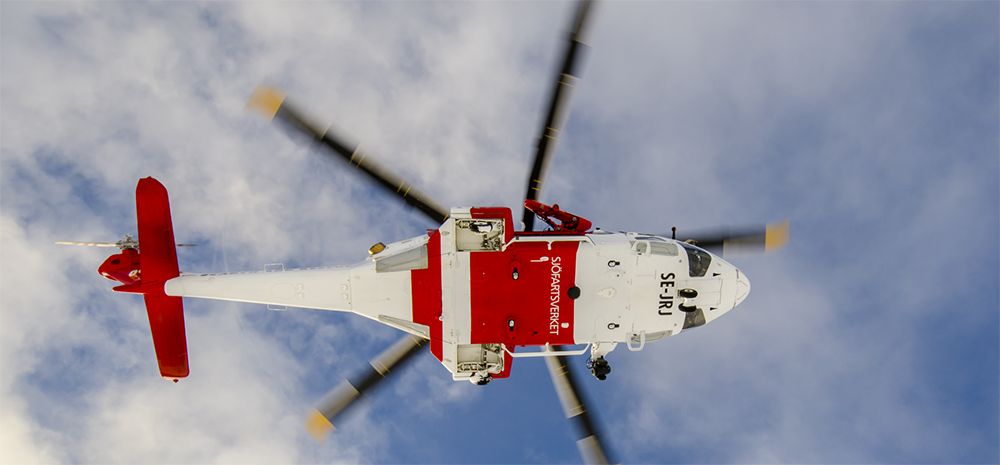
Helicopter Operations
The Swedish Maritime Administration is responsible for ensuring the availability of rescue helicopters for national maritime and aeronautical search and rescue operations. The helicopters and their crews operate from our bases in Umeå, Norrtälje, Kristianstad, Visby and Gothenburg.
In addition to operational activities, the administrative office is located in Gothenburg. This office is responsible for functions including strategic planning, technical maintenance, scheduling and training.
The Swedish Maritime Administration's helicopter crews consist of four members: two pilots, a winch operator and a rescue swimmer.
For a standard mission, the crew must be changed into their operational gear and ready for duty within 15 minutes of receiving an alert. The helicopter must also be moved out of the hangar and ready for take-off. The time between receiving an alert and the helicopter taking off depends on the planning required for the specific rescue operation.
Weather conditions, distance and the type of rescue operation are examples of factors that influence this planning.
AW139 Helicopter
The AW139 is a modern twin-engine helicopter manufactured in Italy by AgustaWestland. It is classified as a medium-weight helicopter and is certified for daytime and nighttime operations, visual flight rules (VFR), instrument flight rules (IFR) and, in its Swedish search and rescue (SAR) configuration, flight in icing conditions.
The AW139 is built in accordance with the latest helicopter airworthiness standards (FAR/JAR 29), which include:
Crash-resistant seats, fuel tanks and structural components
Fail-safe design and system redundancy
Damage tolerance (FAR/JAR 29.571)
Turbine containment in the event of overspeed
Capability to operate for 30 minutes without gearbox oil
Bird strike protection
Enhanced protection against electrical interference, lightning strikes and other hazards
Improved single-engine performance requirements
Enhanced structural requirements (90° yaw at 0.6 VNE)
The AW139 is a five-bladed helicopter featuring a spacious, open, rectangular cabin with two large sliding doors, one on each side. In its transport configuration, the cabin can accommodate either 12 or 15 passenger seats. The cabin has six large emergency exits, each equipped with automatic emergency lighting.
A large baggage compartment is located behind the cabin. It is accessible during flight and also has external access doors on both sides of the helicopter.
The cockpit features advanced instrumentation and avionics, known as a glass cockpit, comparable to those found in large commercial aircraft. It also includes a highly sophisticated autopilot system with dedicated search and rescue (SAR) modes.
Last updated 2026-11-06